
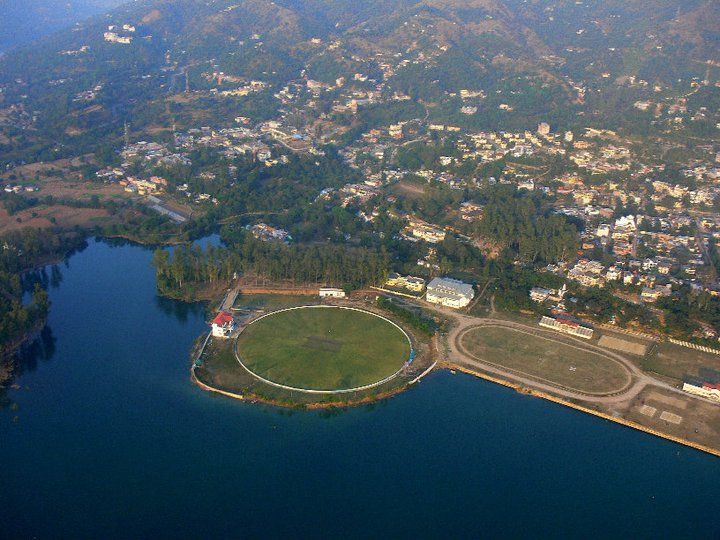
The largest man-made, Govind Sagar Lake is present here …
Shivaksh Sharma
After the partition of India and Pakistan, when Bilaspur became a separate state on October 12, 1948, Raja Anand Chand became its chief commissioner. Bilaspur was merged with Himachal Pradesh on 1 July 1954 and Raja Anand Chand’s dream of an independent Kahlur state was shattered. In this way Bilaspur also became the fifth district of Himachal Pradesh. The boundaries of the district are contiguous with Mandi, Hamirpur, Una, and Solan. The area of Bilaspur is 1167 square kilometers. Bilaspur is a purely mountainous region and it was known throughout the country by the name of seven edges. In these seven streams, Dhar Nayana Devi, Kotdhar, Dhar Jhanjiar, Dhar Tiyun and Dhar Striyun, Dhar Bandla and Bahadurpur Dhar.
As soon as the Raj power ended, a new era of development started in Bilaspur and now there has been unprecedented development in every field. The plan for the construction of Bhakra Dam in Bilaspur was made in 1918 during the time of Lieutenant Governor of United Punjab, Lewis Don. Its construction began in 1948 and was completed in 1963. The well-known Sandu Maidan, the market located here, the temple, the ancient palace, and about two hundred villages, including the fertile area of Chaunta Valley, were all submerged on August 9, 1961. Now here at those places is the world’s largest man-made Govind Sagar lake. In this, many means of employment are available including fishing, boating, water sports.
When Raja Anand Chand raised the issue of the submergence of the old city in Bhakra with the Government of India, the Chief Architect of the Government of India, Juglekar, made a map of the new city. The construction of the city started in 1956 and was completed in 1963. In the first stage, it was identified with the format of three sectors, Rauda, Diara and Changar, but after that people started building buildings on their own and according to the architect, this city could not develop.
Nayana Devi Temple is considered to be the biggest holy place in district Bilaspur. This historical temple is a very holy place for Hindus and Sikhs. Tenth Patshahi Guru Gobind Singh’s mother had immense faith and devotion towards Nayana Devi. Along with this, there are other religious places including Nahar Singh Temple, Vyas Cave, Markandeya Rishi Temple.
From the point of view of health, the AIIMS Institute in Bilaspur has been built in Kothipura. The work of providing railway line in the district is in progress. Four laning projects are in progress. Bilaspur district is now included in the list of advanced districts in every category including education, industry.
For more information, follow our Social Media Handles.
Facebook – https://www.fb.com/digitalbaalmela/
Instagram – https://instagram.com/digitalbaalmela
Twitter – https://twitter.com/DigitalBaalMela
Youtube – https://bit.ly/3xRYkNz