
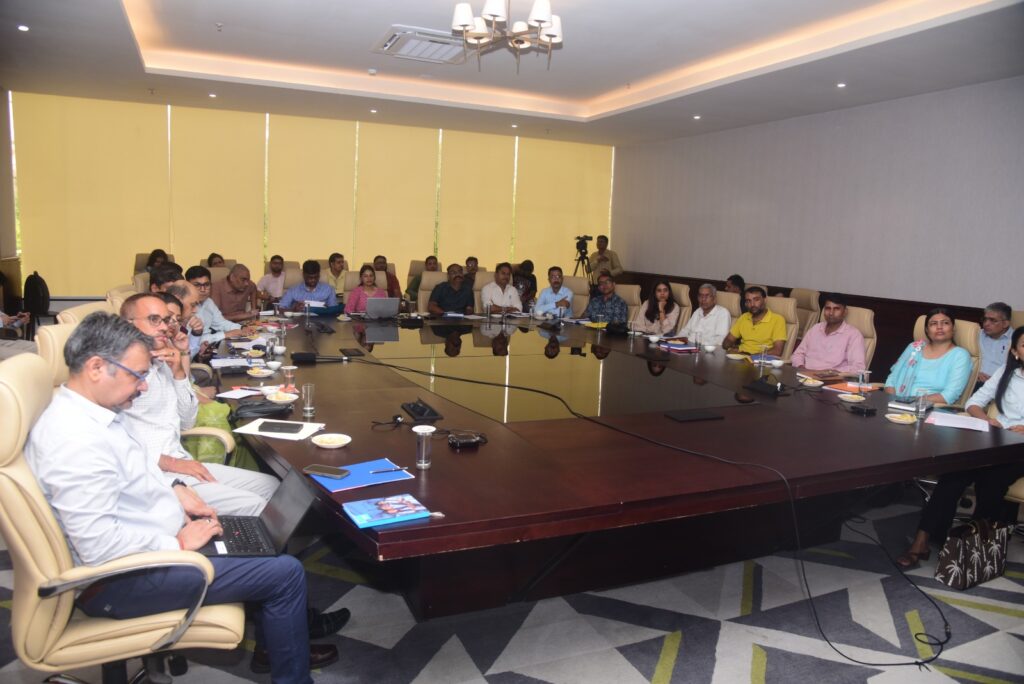
Media Workshop Organized at the Constitution Club on World Environment Day
Jaipur: A media roundtable, organized jointly by UNICEF and the Future Society at the Constitution Club, featured various sessions involving journalists as well as experts in the fields of environment and meteorology. During the event, extensive deliberations were held regarding the adverse impacts of escalating heatwaves, water crises, erratic rainfall, and drought-like conditions in the state on health, education, nutrition, and water security.
Opening the program, Rushabh Hemani, UNICEF’s Head for Rajasthan, stated that climate change is no longer a developmental crisis of the future, but a pressing crisis of the present. Its impact is felt most acutely by children, pregnant women, the elderly, and vulnerable sections of society. In particular, the dual challenge of extreme heat and water scarcity places an additional burden on women and girls. He noted that in 2023, a state-level climate consultation meeting—the first of its kind in Rajasthan—was organized, bringing together various government departments, technical institutions, and development partners to discuss the emerging climate risks facing the state. This initiative served to strengthen inter-departmental coordination and foster a shared strategy for climate adaptation.
Addressing the workshop, UNICEF Chief K.L. Rao highlighted that, within the health sector, UNICEF has collaborated with the Department of Medical and Health to support the implementation of the National Programme on Climate Change and Human Health. Under this initiative, District-level Programmes on Climate Change and Human Health have been established across all districts of the state; these units are instrumental in identifying and monitoring climate-induced health risks, as well as ensuring better coordination during times of disaster. In the realm of education, UNICEF has partnered with the Department of School Education to develop a specialized teaching module on heatwaves for government schools. Through this module, students and teachers are being sensitized to the causes of extreme heat, associated illnesses, preventive measures, water conservation, and environmental protection. Describing water security as the foundation of climate resilience, Radheshyam Sharma, Head of the Meteorological Centre, stated that Rajasthan’s water resources are facing increasing pressure due to rising temperatures, erratic rainfall, and groundwater depletion. In collaboration with the Public Health Engineering Department (PHED) and other agencies, efforts are underway to strengthen source conservation, groundwater recharge, rainwater harvesting, water budgeting, and monitoring mechanisms. Furthermore, under the vision of ‘Viksit Rajasthan-2047’ (Developed Rajasthan-2047), support has been extended toward defining key indicators for achieving a water-secure Rajasthan.
During the workshop, two online sessions were conducted featuring Yusuf Kabir, Climate Change and Environmental Sustainability Specialist at UNICEF, and Professor Mahaveer Golcha of IIPH. They provided insights into mitigation measures against rising temperatures and presented details regarding government initiatives.
To bolster environmental health, UNICEF is also providing technical assistance to strengthen solid and liquid waste management systems under the Swachh Bharat Mission. Emphasis is being placed on creating a clean and healthy environment by promoting Resource Recovery Centres (RRCs) and community-based waste management models.
Ankush Singh, Communication Specialist at UNICEF, announced that with the aim of fostering youth leadership, UNICEF is launching the ‘Youth for Climate Action’ initiative in collaboration with the Rajasthan Youth Board. Through the Swami Vivekananda Youth Portal, young people will receive training on subjects such as climate science, climate policy, green jobs, sustainable development, carbon markets, and community leadership. The objective is to cultivate a cadre of climate-aware and active youth leaders across the state.
Dr. Meena Sharma, Secretary of the Future Society, stated that in the coming years, climate-resilient health services, water security, climate-smart schools, and youth engagement will be further strengthened to safeguard the lives, education, and future of children amidst the evolving environmental landscape. A large number of journalists were present at this workshop, including Jaipur’s Goverdhan Chaudhary, Raghu Aditya, Archana Sharma, Shoaib Khan, Kailash Chaudhary, RJ Shivangi, Arvind Palawat, and Ved Prakash.